Yala National Park Safari, Sri Lanka
It’s 4:30am on a cool(ish) morning for Sri Lankan standards. I’m standing with five other bleary eyed yet excited people, waiting for the final payments to be sorted. We expectantly await the arrival of our ‘specialised all-terrain vehicle’ while the roosters crow insistently into the morning stillness.
The vehicle turns out to be a mish-mash between classic ‘Australian work ute’ and ‘Demolition Derby Truck’ and has been retrofitted with six faux-leather, cushioned seats in the tray. Looking at the seats before climbing in, I can’t help but think the seats once belonged to cars destined for the scrap heap. This observation was almost immediately confirmed upon sitting down and searching for the seat belt, which in contrast to the shiny white exterior of the vehicle, turned out to be as rusty as a neglected boat trailer. Despite the shortcomings, the retrofit was a success in terms of passenger vantage points, arguably the most important aspect of this half-day adventure. Mimicking any good theatre seating plan, each pair of seats are positioned slightly higher than the pair in front to ensure everyone gets the best possible view. Now that we’re not quite buckled in, we’re ready to go on safari in Yala National Park.
Yala National Park is located on the east coast of Sri Lanka and spans an impressive 978km2. Home to hundreds of wild Sri Lankan Elephants and the world’s most dense population of Leopards (approximately 700 – 1000 leopards live in Sri Lanka), Yala National Park has been a recognised protection area since the year 1900. In the following hundred and nineteen years, the park has expanded its physical size and also recognised its importance for a large variety of species conservation. However, with tourism in Sri Lanka well and truly taking off, I do wonder how this important area is going to be sustainably managed in the long run?
The safari vehicle zooms along the empty roads between the town of Tissamaharama and Yala National Park for around forty minutes. It’s a wonderful opportunity to look up at the pre-dawn sky and admire the bright twinkling stars (you may have already guessed that this specialised vehicle also has no windows in the back). It’s the kind of starry twinkle only possible in remote areas well away from cities and their artificial lights.
“Elephant, M’aam can you see the Elephant?” exclaims the driver with his head stuck out the driver’s side window. Sure enough, we haven’t even made it to the official park area and there before us is a medium sized Sri Lankan elephant, happily munching away in the darkness, completely unphased by the vehicle lights beaming directly at its wrinkly head.
Arriving at the Park’s registration centre, our driver jumps out and announces that we need to wait here while he organises the ticket. For the next twenty minutes a growing concern was brewing in my mind and it had nothing to do with our driver. Instead, it had to do with the realisation that we weren’t the only people going on a safari today. In fact, we are one safari vehicle of at least eighty (yes, eight zero) on this off-peak-tourist-season Sri Lankan morning. To my horror, I discovered that Yala National Park sees two half day safaris every single day. And during peak tourist season, the park will host literally hundreds of safari vehicles every single day.
Now, as we wait in the morning light for our driver to return, I am stewing with thoughts about what long term impacts this might be causing on both the animals and the place they call home. I was having serious second thoughts about this experience but unless I wanted to sit by the side of the road in the heat for the next six hours with only ants and snakes as company, I had no choice but to continue on with the safari whether I agreed with the way it was run or not.
The Yala National Park gates open at 6am, and it feels like I have suddenly entered a safari version of go-kart racing combined with dodgem cars. The safari vehicles, once through the gate, left all politeness aside and we were literally racing, trying to get away from the other vehicles and presumably trying to spot the animals before anyone else. There is a huge cloud of orange dust swirling around us until we are suddenly in the midst of a jungle traffic jam (one of many this particular morning) involving five or six safari vehicles, all stuck at different angles on a single lane dirt road.
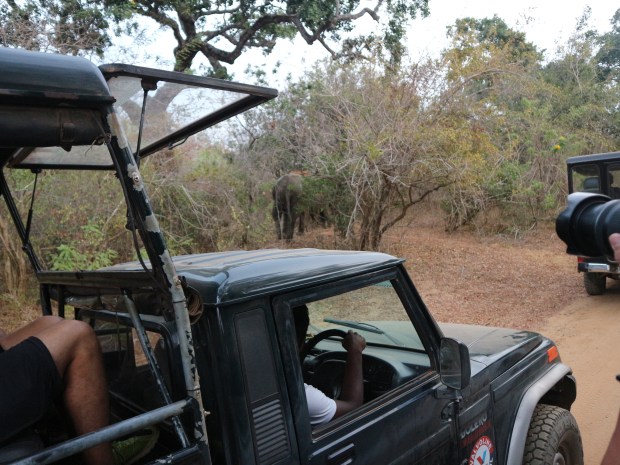
Ten minutes into the mayhem we spot three elephants (two adults and one baby) right by the edge of the road. As we get closer, the driver notices another vehicle coming from the other direction, so he speeds up to get there first and of course, the other driver does exactly the same thing. So, with both vehicles speeding towards each other (and the elephants) we suddenly come to an abrupt halt only meters from the feasting elephants, which in turn, swiftly turn their gorgeous leathery behinds to us and walk deeply into the bushland where they can continue their breakfast in peace. So yes, we just saw some elephants, but this is certainly not turning out to be the stealthy David Attenborough experience I had imagined.
An hour, maybe two go by and we pass other weary safari-goers, slightly orange with dust and wearing faces that say “we haven’t seen anything all morning, have you?”
As the morning wears on, the pace slows down, a little. We bump and jump our way all over the Park spotting crocodiles, goannas and wild pigs. Coming from North Queensland, these animals were fun to see, but didn’t exactly get my camera clicking. Finally, after I had packed away my camera in utter defeat, we spot a lonesome elephant, by a waterhole spraying itself with water to beat the midday heat. We watch from a distance and are the only safari goers around for a few precious minutes. Long enough for me to get a slice of what David Attenborough’s team must feel like during their countless successful expeditions.

After the chaos and doubts of the morning, the scenario was beginning to slightly redeem. I kept my camera out with a new sense of optimism and was rewarded with sights of grey, pink-bummed and cheeky black faced monkeys playing family in the trees, we saw a pair of crafty jackals, blue-green bee eaters, and a mongoose. We stopped for a snack of fresh pineapple and watermelon before hearing some people swear they just saw a sloth bear on a rock in the distance…
The drive back was as dusty and bumpy as ever, and gave me some time to reflect on the day. I love animals and I love being amongst nature, but was this really the best or most sustainable way of experiencing this unique part of Sri Lanka? I think not. What I’ve learnt from this experience is to do my homework. If you must go on safari (or any other wildlife encounter) be sure to find a company that treats the animals and their home with the respect they deserve. ‘Green travel’ is becoming more accessible and more common across the world and it’s something I will certainly be looking into next time I decide to go on an ‘adventure’.


 Yogini Engineer